Aftab Alexander Mughal
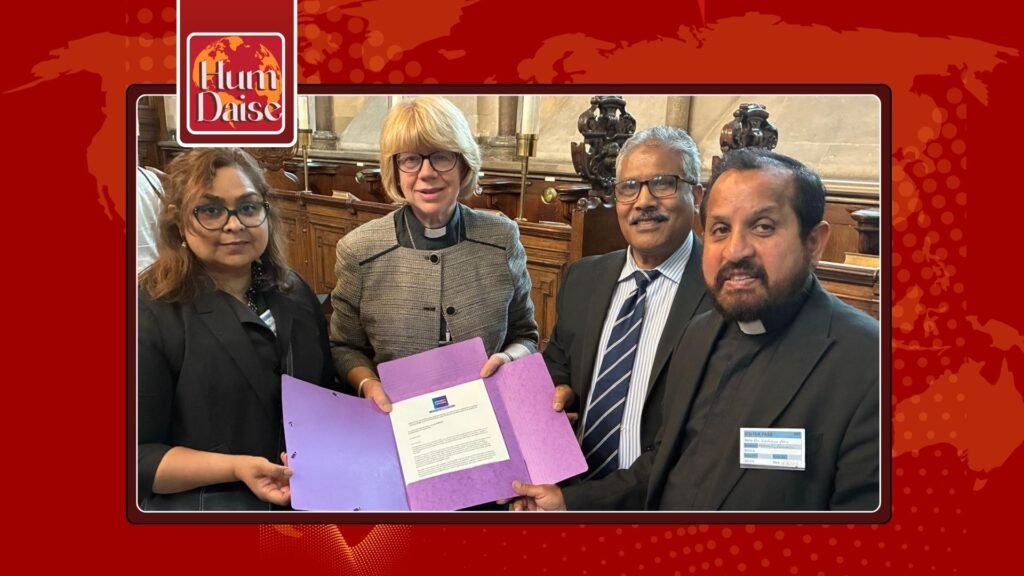
On 16 June, a delegation from Minority Concern, a UK-based minority rights organisation, presented a petition to the Archbishop of Canterbury at Lambeth Palace in London.During the visit, the Archbishop hosted a special evening prayer service in the chapel at Lambeth Palace, where prayers were offered for Pakistani Christians, particularly Christian girls who have been victims of forced conversion and forced marriage.Following the service, the Minority Concern delegation—Aftab Mughal, Revd. Saleem Gurdas, and Esther Das—formally presented the petition during a meeting with the Archbishop.The petition began by congratulating Her Grace on her appointment as the first woman Archbishop of Canterbury, assuring her of prayers as she begins her ministry, and expressing the hope that God will grant her wisdom, courage, and compassion in addressing the challenges and opportunities of our time.Minority Concern (UK) is an advocacy organisation working to raise awareness of the challenges faced by religious minorities in Pakistan, including Christians, Hindus, Sikhs, and other vulnerable communities. Through advocacy, public engagement, and dialogue with faith leaders, policymakers, and civil society organisations, we seek to promote human dignity, freedom of religion or belief, equal citizenship, and the protection of fundamental human rights.
The petition stated:
“We sought your prayers and support regarding the ongoing plight of Christian girls in Pakistan who are vulnerable to forced conversion and forced marriage. These cases represent some of the most serious human rights concerns facing religious minority communities today and continue to cause deep suffering for victims, their families, and their wider communities.”Pakistan’s religious minorities make valuable contributions to society, yet many continue to face discrimination, social exclusion, economic disadvantage, and limited access to justice. Within this broader context, young Christian girls are particularly vulnerable. Reports from human rights organisations, community leaders, and affected families continue to highlight cases in which girls are abducted, coerced or pressured into converting to another faith, and married against their will. Families often face significant social and legal barriers in seeking protection and pursuing justice.Behind every statistic is a young person whose childhood, education, safety, and future have been disrupted. Families affected by these experiences frequently endure trauma, fear, and uncertainty, while many feel their voices remain unheard. The emotional, social, and spiritual impact can be profound and long-lasting.“As Christians, we are called to uphold the dignity and worth of every human being, particularly those who are vulnerable. The protection of children and young people is not only a human rights concern but also a safeguarding imperative. We believe the global Church has an important role in standing alongside those who suffer injustice and in speaking with compassion and conviction on behalf of those who cannot speak for themselves,” the petition said.It further noted that the Archbishop’s voice carries significant moral and spiritual authority across the Anglican Communion and beyond. Public recognition of these concerns would bring encouragement to affected communities and help draw attention to the need for greater protection of vulnerable minority girls. It would also reassure families that the wider Church has not forgotten them.The petition also acknowledged and appreciated the Church’s longstanding commitment to justice, peace, reconciliation, safeguarding, and the defence of human dignity. It stated that these values provide a strong foundation for continued engagement with issues affecting vulnerable religious minorities worldwide.It respectfully requested that the Church continue promoting awareness of the challenges faced by minority communities in Pakistan and support efforts that advance religious freedom, equal rights, and the protection of children and young people. It also called for greater dialogue between church leaders, safeguarding practitioners, human rights advocates, and affected communities to explore practical ways of strengthening protection for vulnerable girls and supporting survivors of abuse and exploitation.
Author
















Leave a Comment
Your email address will not be published. Required fields are marked with *