Kamran Rashid
(All individuals named in this story are given fictitious names to protect identities. Facts,
figures and statements come from the published reports listed under Sources, and are
attributed to those outlets.)
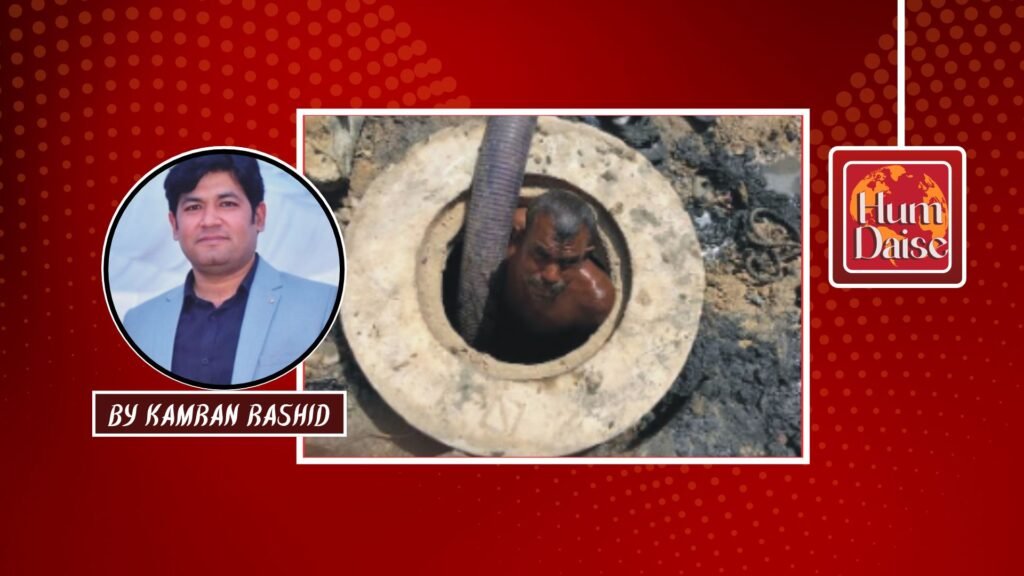
It was already past midnight on September 19, 2025, when three men were sent down a manhole on Satyana Road to fix a sewer connection. According to The News ,on Sunday, they asked to wait until morning so they could get WASA’s permission and
safety gear. The business owner who hired them reportedly refused. Within moments, a relative said, all three had passed out from toxic gas. None survived. “I rushed to the site as soon as I heard,” William (a fictitious name), a brother of one of the dead men, told that newspaper. “By then it was too late.” The police complaint, as reported, was registered under Section 322 of the Pakistan Penal Code, a provision whose maximum penalty is payment of blood money. William said no arrests had been made, and that police had not added charges of criminal negligence or forcing workers into dangerous tasks.The case is only the latest entry in a long ledger.
A pattern, not an accident
The News on Sunday counted at least 14 people who died in Faisalabad’s sewers and manholes in 2024 alone. The deadliest incident was on June 13, 2024, in Dijkot, where five sanitation workers suffocated. Earlier that year, on March 17, two young men died in a manhole outside a wedding hall on Sargodha Road. In July, two more died in a private housing colony in Chak Jhumra.
The deaths have continued. On September 22, 2025, three days after the Satyana Road deaths, another sanitation worker was left in critical condition after inhaling gas during desilting work in Ghulam Muhammad Abad. In May 2026, UCA News reported that Michael (a fictitious name), a father of three, died in Faisalabad after inhaling toxic gases in a sewer, while a colleague
remained hospitalised in critical condition.The problem is old. In August 2014, The Express Tribune reported that WASA workers
blocked Station Chowk after a colleague died of suffocation in a manhole. Workers said they had repeatedly asked officers for masks, helmets and gloves and received nothing. Nationally, the Citizens Commission for Equality and Human Rights says sanitation workers die every year while cleaning clogged sewers without proper safety measures. A Centre for Law and Justice survey reported by Dawn in 2024 counted 84 sewage worker deaths in 19 districts of Pakistan over five years.
What the rules require and what workers describe
On paper, the standard is high. According to The News on Sunday, the Punjab Local Government and Community Development Department has a mandatory list of 17 safety items for sewer workers. It includes multi-gas detectors, fresh air respirators, rescue
harnesses, tripods and winches, air blowers, helmets, boots and gloves. WASA Faisalabad’s managing director has said that it uses gas detectors, masks and oxygen cylinders, that staff receive safety training and that mechanical desilting machines have been procured. The newspaper also reported that after the September incident, WASA’s deputy managing director issued written instructions to ensure protective equipment was supplied. Workers describe a different reality. Anwar (a fictitious name), president of a WASA employees’ union, told the paper that what is issued as a gas mask is a basic mask attached to a roughly 20-foot
pipe that makes breathing harder in a manhole. He said workers need oxygen cylinders and rescue training, and that no one receives proper training at recruitment. In remote tehsils, he said, the only safety gear may be a rope tied around the waist. The union wrote to WASA’s managing director demanding proper gear for frontline staff, and field workers told the paper the written instructions remain largely unimplemented. A right-to-information request filed with WASA Faisalabad in April 2025 sought certified data on equipment availability, deaths and injuries on duty, and any inquiries held.According to The News on Sunday, the agency did not provide the information, and an appeal is pending before the Punjab Information Commission. The same pattern appears in a joint study by Amnesty International and the Centre for Law and Justice, released in July 2025 and cited by UCA News. Only six of the 66 workers surveyed said they had received occupational safety training.
Who is responsible when a worker dies?
In many deaths, the first dispute is over who the dead men were working for.After the March 2024 deaths, Morning Star News reported that WASA and the Faisalabad Waste Management Company (FWMC) said the men had not died in the course of official
duty. The wedding hall’s management, meanwhile, said government departments should have supplied the safety equipment.
Rights groups, including Human Rights Focus
Pakistan, alleged that the workers were forced into the manhole with no masks or hygiene kits. A British Asian Christians report alleged that WASA and police officials pressured the families to drop the case. Those allegations are unverified.In Sahiwal in April 2026, UCA News reported that two sanitation workers died in a manhole. A WASA contractor filed a police complaint against a subcontractor, a relative of the dead men. Ruth, founder of a sanitation workers’ advocacy campaign, said the case appeared to be an attempt to shield the main contractor. A union official, Zubair, said the men were privately engaged and allegedly ignored standard procedures, but added that their families would still receive financial assistance. Police said the subcontractor would
be investigated for negligence.Compensation is another gap. Under the Workmen’s Compensation Act of 1923, employers must compensate workers killed or injured on duty, including temporary and contract workers. The News on Sunday reported that WASA Faisalabad compensates only its permanent employees, that work charge staff depend on ad hoc provincial
government grants, and that in private cases families are often pressed to accept.”We have to run from office to office,” Anwar said.Tahir, a member of a citizens’ rights commission, argued for a law making unauthorised manhole entry illegal and for an end to private sewer cleaning. Most recent deaths, he said, involved privately hired workers. He also said imported sewer cleaning vehiclesoften sit idle.
Wages, contracts and benefits
Safety is only one of the pressures. Sanitation workers in Faisalabad have repeatedly protested over unpaid wages. In December 2023, strikes left the city’s garbage uncollected, according to Pro Pakistani. In February 2020, Dawn and The Express Tribune
reported that WASA laid off about 900 daily wage employees citing a financial crunch.The pattern continued into 2026. In April, The Express Tribune reported that hundreds of workers had gone two months without pay under an outsourced arrangement. A labour leader alleged that the outsourcing company was bound to register workers with Social Security and the Employees’ Old-Age Benefits Institution (EOBI). In late May, workers in Faisalabad, Dijkot and Tandlianwala said they had gone 56 days without salaries.
Faith, caste and the lowest pay grade
Rights groups say the risks fall hardest on one community. UCA News reported that Christians make up about 80 percent of Pakistan’s sanitary workforce, while Human Rights Focus Pakistan has put the share in Faisalabad at about 90 percent.UCA News also reported that agencies continue to advertise “Christian only” sanitation jobs, despite a 2023 Supreme Court order banning the practice. Petras, a minority-rights lawyer, said more than 50 Christian sanitation workers have died in Faisalabad because of
missing safety gear, and that a court-ordered provision of kits has not been implemented.
Families left behind: the cost after the funeral
The loss of a sanitation worker does not end when the body is brought out of a manhole. When the deceased was the household’s main earner, a widow and children can be left facing rent, food, school fees and medical bills while they try to establish who employed the worker and who is responsible for compensation.
The published accounts cited in this report describe families having to pursue compensation and answers from multiple offices. AsiaNews reported that Yaqoob and Sunny, who died in the March 2024 incident outside a wedding hall, each left behind a wife and three children. The families’ own accounts are essential to understanding what happened after the deaths.
Questions to ask:
Was the deceased the main breadwinner of the household? What income did the family lose?
Who hired the worker, and was the family told whether he was working for WASA, a contractor or a private customer?
Did anyone explain the circumstances of the incident to the family?
Has the family seen an inquiry or police report?
Has the family received compensation, assistance or wages owed?
From whom, how much and on what date?
What expenses or debts has the family faced since the death, and have any children had to leave school or change their plans?
What action does the family want from WASA, the employer, the police and the Punjab government?
A sister’s perspective:
“When my brother was alive, even a small amount he brought home helped us buy groceries and pay the bills. After his death, every household expense became a question mark. We are not asking for sympathy alone we want to know who was responsible for sending him into that sewer and why he was not protected.”
A mother’s perspective:
“I sent my son to work so that our family could survive, not so that he would never return. No mother should have to wait for news that her child has died because he entered a manhole without proper protection. We need answers, and we need to know whether the family will receive the compensation it is entitled to.”
A brother’s perspective:
“We were told that sewer work was his job, but no job should mean risking a life without a gas detector, breathing equipment and a rescue team. If a worker refuses to enter an unsafe manhole, he should not be threatened with losing his wages. The people who hire workers must also be held responsible for their safety.”
Inside the manhole: workers describe the risks
Shokat (a fictitious name)
“We are often ordered by our supervisors to enter manholes without checking dangerous gases. We do not have proper safety equipment such as gas detectors, breathing masks, harnesses and rescue tools. There is no trained rescue team available, and we have not received proper safety training. We are afraid to refuse dangerous work because we may lose our wages. Many of us work through contractors, and payments are sometimes delayed. I have seen workers collapse due to poisonous gases, but proper investigations are not always carried out. We only want safe working conditions so that we can return home alive to our families.”
The second man, Bilal (a fictitious name), said:
“We are human beings too. We have children and families. We come to work to earn a living for them, but every day we put our lives at risk. We request the government to provide us with safety equipment, proper training and a safe working environment.”
The questions that remain
The deaths raise questions that no single agency has yet answered publicly:
How much of the 17-item equipment list has WASA Faisalabad actually bought and
issued, and where are the records?
Who is accountable when workers are hired privately to enter a public sewer, and why are charges often limited to blood money?
Why are contract and work-charge workers left outside routine compensation?
Will the pending information appeal produce the injury and fatality data that WASA has not released ?
Author
















Leave a Comment
Your email address will not be published. Required fields are marked with *