
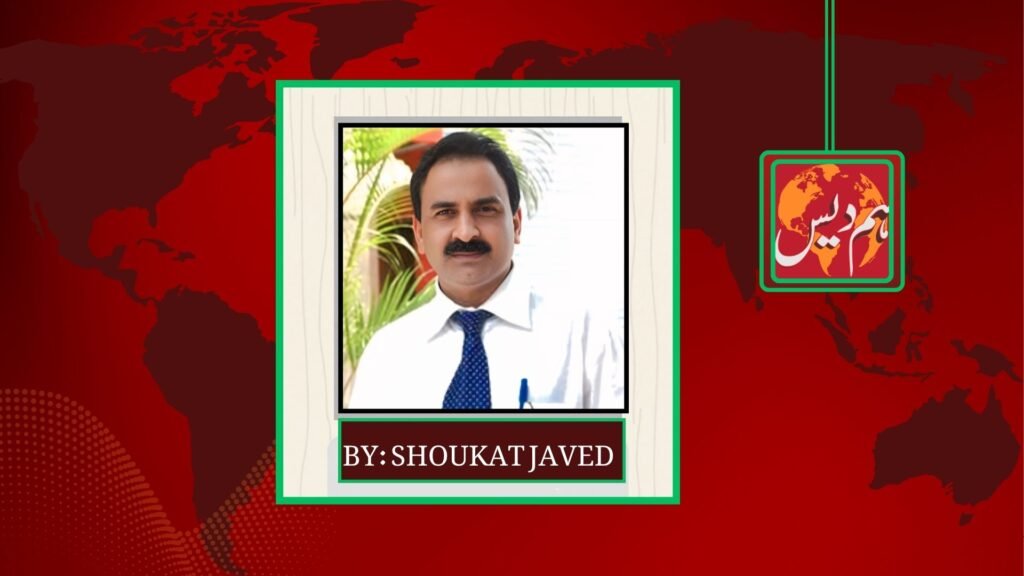
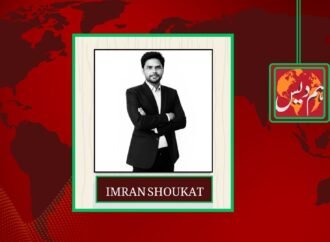
Written by: Shoukat Javed
Since 1947, whenever the Pakistani child has been taken to the political laboratory for a medical check-up, the political doctors have always given the same report: “The child is at a highly critical stage.”
Its inflation cholesterol has reached an alarming level. The veins of unemployment have almost collapsed. Its heart, burdened by ethnic and provincial conflicts, is struggling to function. The kidneys of positive and constructive thinking have failed.
And the people, exhausted like helpless parents, have often remained silent, accepting the situation as the will of God.
Now, Pakistan Tehreek-e-Insaf (PTI) has announced a long march and protest towards Islamabad on September 27, 2026. Once again, it is attempting to free this ailing child from the diseases that have afflicted it for decades—although, at present, the chances of success may appear distant.
But there is one thing we must remember: there is a Power that can make an elephant fall through something as small as an ant. A Power that can be seen and yet cannot be seen, and which is also known as the God of miracles.
The PTI leadership has described the planned protest as peaceful, while the government has made it clear that roads and public places in Islamabad will not be allowed to be blocked.
But if we take a brief look around, we find that even before the protest has begun, the government itself has already placed containers and blocked major routes and motorways in an effort to prevent the march from reaching its destination.
This situation is not merely a confrontation between one political party and the government. The real question is: Does Pakistan have the capacity to resolve its political differences through constitutional and democratic means rather than through confrontation?
The Islamabad High Court has also emphasized that political parties and leaders do not have an unlimited legal right to occupy public roads, highways or other places in a manner that interferes with the movement of ordinary citizens. The court has also directed provincial governments to ensure that public resources are not misused for political protests and that the constitutional rights of citizens are protected.
On the other hand, PTI maintains that peaceful protest is its constitutional and democratic right, and the party has reiterated its intention to hold a peaceful march on September 27. PTI Chairman Barrister Gohar Ali Khan has also reiterated this position in recent days.
This is precisely where the responsibility of both the state and political parties becomes greater.
The responsibility of the state is to ensure that the law is applied equally to everyone. If a protest is permitted, there should be clear rules governing it. If restrictions on a particular location are legally necessary, the reasons and legal basis for those restrictions should be clearly communicated to the public.
Similarly, it is the responsibility of the political party to ensure that the protest remains peaceful, that public and private property is not damaged, that ordinary citizens’ routes are not unnecessarily blocked, and that confrontation with law-enforcement agencies is avoided.
Pakistan is already facing political polarization, economic difficulties and a serious crisis of trust among institutions. If political differences turn into confrontation on the streets, the damage will not be limited to the government or the opposition. The greatest cost will ultimately be paid by ordinary citizens.
Markets, educational institutions, offices, businesses, patients, travelers and daily-wage workers are often the first to suffer when political tensions escalate.
Political leadership must therefore remember that the purpose of protest is to give voice to the people—not to create additional difficulties for them.
At the same time, the government must also understand that political protests cannot be treated merely as an administrative or security issue. Their political causes must also be addressed. Keeping the door to dialogue open, listening to grievances and finding constitutional solutions are signs of strength in any democratic system.
In recent days, government announcements aimed at stopping the march and PTI’s determination to proceed have increased political tensions. The arrests of some workers and political figures have further complicated the situation. Since the government and PTI have presented different positions regarding these arrests, such claims should not be treated as established facts without considering the relevant legal proceedings and credible evidence.
September 27 is not merely a date; it could become a test of Pakistan’s political maturity.
If the protest takes place, it should remain peaceful. If the government has security concerns, those concerns should be addressed through law, constitutional procedures and dialogue rather than unnecessary confrontation.
If the opposition has grievances, it should continue to use constitutional institutions, Parliament and the courts to pursue them. And if citizens support a particular political party, respect for their political rights is also an essential part of democracy.
Political disagreement is not new to Pakistan. Difference of opinion is a natural feature of democracy. But turning disagreement into hostility and protest into confrontation weakens democratic institutions.
Today, there is a need for both the government and the opposition to send a clear message to their respective supporters:
The law will not be taken into one’s own hands. Public property will not be damaged. The fundamental rights of citizens will not be violated. And political differences will not be allowed to turn into violence.
Pakistan needs to listen to one another more than it needs to defeat one another.
But if political temperatures continue to rise and the power of the state and public protests come face to face, the question will not simply be who won and who lost.
The real question will be:
What did Pakistan lose?
Therefore, today, every political leader, every political worker and every institution should carry one clear message:
Pakistan’s path out of crisis is not confrontation. It is the Constitution, the rule of law, dialogue and democratic tolerance.
Because…
Pakistan Is Once Again at a Critical Turning Point









Leave a Comment
Your email address will not be published. Required fields are marked with *