
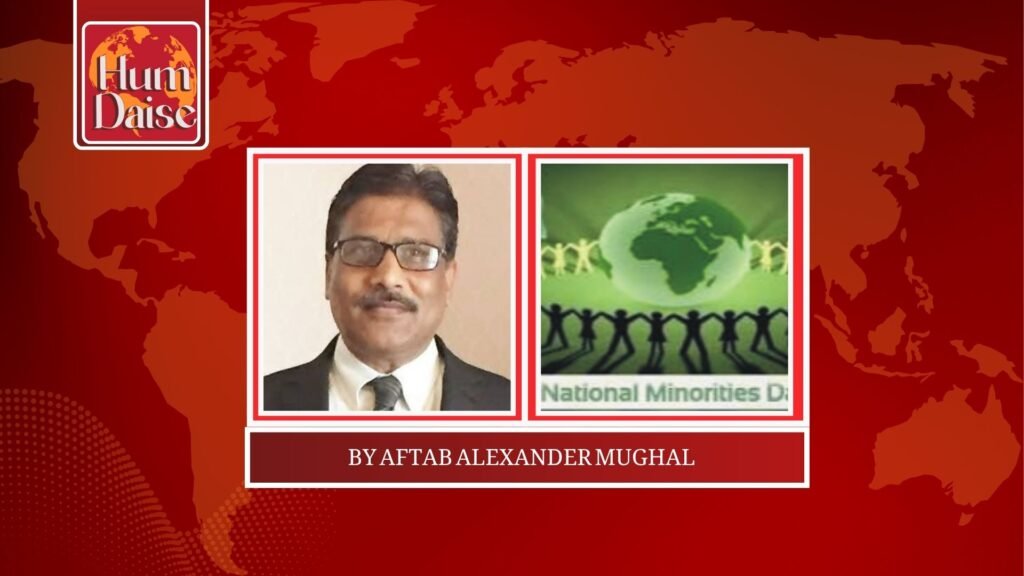
By Aftab Alexander Mughal
Every year on 11 August, Pakistan observes National Minorities’ Day to recognise the contributions of its religious minority communities and reaffirm the principles of equality, religious freedom, and social harmony. The date commemorates Quaid-e-Azam Muhammad Ali Jinnah’s historic address to Pakistan’s Constituent Assembly on 11 August 1947, in which he articulated a vision of a state where all citizens, regardless of their religion, would enjoy equal rights and responsibilities.
In his landmark speech, delivered shortly before Pakistan’s independence, Jinnah emphasised that every citizen should be free to practise their faith and that religion should not determine a person’s relationship with the state.
He said, “You are free; you are free to go to your temples, you are free to go to your mosques or to any other places of worship in this State of Pakistan. You may belong to any religion or caste or creed—that has nothing to do with the business of the State.”
For many Pakistanis, this address remains a defining reference point in discussions on citizenship, religious freedom, and minority rights. Recognising the significance of Jinnah’s vision, the Pakistan Peoples Party (PPP) government officially declared 11 August as National Minorities’ Day in 2009.
Pakistan is home to diverse religious communities, including Christians, Hindus, Sikhs, Parsis, Baháʼís, Kalash, and others, alongside the Muslim majority. Members of these communities have made valuable contributions to education, healthcare, public service, business, the armed forces, sports, science, the arts, and culture. National Minorities’ Day provides an opportunity to acknowledge these contributions while promoting greater understanding and respect among all citizens.
Over time, the significance of the day has expanded beyond symbolic recognition. While earlier observances primarily celebrated the achievements and services of minority communities, National Minorities’ Day has increasingly become a platform for discussions on constitutional rights, equal opportunities, political participation, religious freedom, and social inclusion.
Government institutions, civil society organisations, religious leaders, academics, journalists, and human rights advocates use the occasion to assess progress in protecting minority rights and to examine the challenges that remain.
Despite constitutional guarantees of equality, many religious minorities continue to experience discrimination and violence. Places of worship and community properties are frequently targeted, while perpetrators often escape accountability. Minority girls remain vulnerable to abduction, forced conversion, and forced marriage. In addition, non-Muslims are often portrayed negatively or inadequately in school curricula and textbooks. Furthermore, Articles 41 and 91 of the Constitution restrict the offices of President and Prime Minister to Muslims, raising continuing concerns about equal citizenship and political inclusion.
Among various institutions, the education sector and the media have particularly important roles to play in bringing religious minorities into the national mainstream.
Educational institutions can use National Minorities’ Day to promote inclusion, celebrate diversity, and challenge prejudice. Schools, colleges, and universities can organise interfaith dialogues by inviting representatives of different faith communities to share their beliefs, traditions, festivals, and lived experiences. They can also introduce special lectures, exhibitions, and classroom discussions highlighting the histories, cultures, and achievements of Pakistan’s minority communities across different fields.
The media likewise has a responsibility to recognise and highlight the contributions of minority communities throughout the year, rather than limiting coverage to a single commemorative day. Fair and balanced representation can help challenge stereotypes, foster mutual understanding, and strengthen social cohesion.
If Pakistan aspires to be a truly pluralistic society, it must embrace its rich diversity of languages, cultures, traditions, and histories as an integral part of its national identity.
The state should encourage educational institutions to promote respect for different beliefs and backgrounds while supporting youth initiatives that use sports, arts, and cultural activities to foster cooperation, conflict resolution, and civic responsibility.
National Minorities’ Day is not merely an occasion to celebrate the contributions of Pakistan’s religious minorities; it is also an opportunity to reaffirm the values of equality, inclusion, and mutual respect. Its true significance lies in encouraging the nation to recognise the diversity of its citizens and to continue striving towards a society in which every individual enjoys dignity, security, justice, and equal opportunities.
Building a peaceful and inclusive Pakistan requires sustained commitment from the state, educational institutions, the media, civil society, and citizens alike. By promoting understanding, protecting equal rights, and respecting diversity, Pakistan can strengthen social harmony and advance shared national progress.















Leave a Comment
Your email address will not be published. Required fields are marked with *