Kamran Rashid
(All names of students, parents, teachers and school principals in the interview sections of this story are fictitious. All statistics, dates and documents cited are drawn from the referenced sources)
A result that demands attention
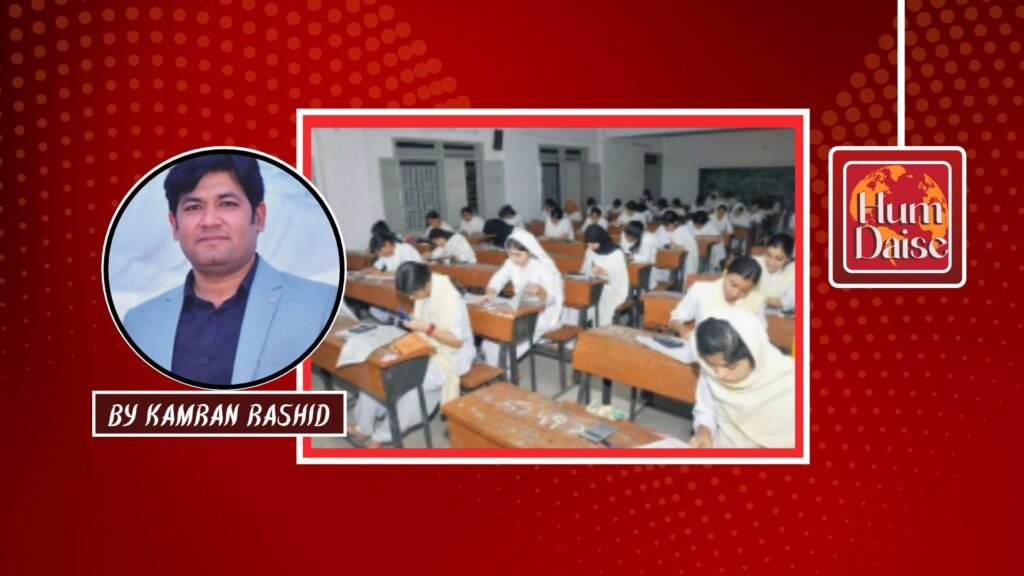
For thousands of students across Punjab, the announcement of the Class 9 examination results in September 2026 brought disappointment, anxiety and uncertainty about the future. For many families, the result was not simply a matter of marks. It raised difficult questions about the quality of education, classroom preparation and the support available to children struggling with their studies.
Figures compiled from the results of Punjab’s nine educational boards show that approximately 1.4 million candidates appeared in the Class 9 examinations in 2026. Of these, 641,662 passed, an overall pass rate of approximately 45.98 per cent. This means that more than half of the candidates did not pass. The figures were reported following the publication of the boards’ result gazettes.
The results raise an important question: why did so many students fail, and what can schools, education authorities and families do to prevent similar outcomes in the future?
Faisalabad’s result reflects the wider challenge
Faisalabad, one of Punjab’s major educational centres, recorded a Class 9 pass rate of 51.21 per cent in 2026. According to figures reported from the Board of Intermediate and Secondary Education Faisalabad’s result gazette, 196,656 candidates appeared in the examination and 100,708 passed.
This means that 95,948 candidates who appeared did not pass. Behind these numbers are students who had to decide whether to prepare for the second annual (supplementary) examinations, repeat subjects or reconsider their educational plans.
All nine Punjab boards, including Faisalabad, scheduled the second annual examinations for the SSC from 6 October 2026, with Class 9 papers beginning on 17 October
However, examination results alone cannot explain why students failed. A proper investigation must examine students’ preparation, their understanding of the syllabus, the time available for teaching, the support provided by schools and the circumstances in which they study at home .
School closures and teaching time
One issue requiring scrutiny is the effect of disruptions to the academic calendar.
In March 2026, the Punjab government announced the closure of educational institutions from 10 March to 31 March amid the fuel crisis. Schools were scheduled to reopen on 1 April. The interruption came during an important period of the academic year, when students and teachers needed time to complete lessons and revise for examinations.
The closure was ordered by the School Education Department as a fuel-conservation measure and covered public and private schools
Examinations already scheduled were to go ahead as planned, and institutions were permitted to continue online classes
After speculation of an extension to 15 April
Education Minister Rana Sikandar Hayat ruled it out and confirmed reopening on 1 April
with a five-day school week
Because online classes were optional, it remains to be established how many Class 9 students could actually attend them.
The closures may have created difficulties for some schools, but it would be inaccurate to conclude that they caused the province-wide failure rate without further evidence. The key questions are how much of the syllabus schools had completed before the closures, whether additional classes were arranged afterwards and which subjects were most affected.
What teachers say (fictitious names)
Ms Saima Nadeem, a Class 9 science teacher at a government girls’ high school in Faisalabad said the closure disrupted the rhythm of lessons.
“We had planned to finish the practical-based chapters and begin revision in March. When the school reopened, we had to choose between rushing through the remaining chapters and revising what students had already studied. Most of us tried to do both, and neither was done as well as we wanted,” she said.
Mr Tariq Mehmood(fictitious name),principal of a private secondary school in Faisalabad said his school arranged extra sessions after the reopening.
“We added Saturday classes and extended the timetable for mathematics,English and computer But attendance in extra classes was uneven. Some students travel long distances, and some families could not manage the additional schedule,” he said.
Both accounts suggest that the impact of the closure varied by school, a point that should be tested with school-level data.
The revised Smart Syllabus: a solution or another challenge?
Another important development was the introduction of the revised Smart Syllabus, also known as the Accelerated Learning Programme (ALP), for Class 9 annual examinations in 2026.
A notification issued by the Punjab Education, Curriculum, Training and Assessment Authority (PECTAA) on 7 November 2025 introduced a revised syllabus, pairing schemes and model papers for the examinations.
The Lahore board lists the Smart Syllabus (ALP / deleted topics), pairing schemes and model papers for Grade 9 (Annual Examination 2026) among its official notifications
PECTAA’s subject documents state that selected topics were reduced to ensure timely curriculum completion within the 2025-26 academic calendar, and that exam questions come from the full textbook except deleted
A corrected Class 9 smart syllabus was later released after errors were removed
which is one reason the clarity of communication to teachers needs to be examined.
The policy was intended to define the content and examination preparation requirements for the academic year. However, the central issue is not simply whether the syllabus was reduced or revised. It is whether teachers received adequate guidance, whether students had enough time to adjust, and whether they had sufficient opportunities to practise the concepts that would be assessed.
What teachers say (fictitious names)
Mr Adeel Hussain(fictitious name), a mathematics teacher at a government boys’ high school said the revised pairing scheme created confusion in the early months.
“The notification came in November, but many students had already been studying the earlier plan for months. Some students thought the pairing scheme meant they could skip entire topics, and then they struggled when questions required deeper understanding,” he said.
Ms Rabia Anwar (fictitious name) an English teacher at a private school said model papers helped but did not solve the underlying problem.
“Model papers gave students a pattern to follow, which was useful. But students who were weak in basic writing and comprehension could not improve just by practising a pattern,” she said.
PECTAA has not been quoted in this draft. Officials should be asked how the revised syllabus was implemented, what guidance was provided to schools and whether the authority has evaluated its impact on student performance.
The training question needs evidence, not assumption. The official notification confirms that PECTAA issued a revised Grade 9 Smart Syllabus, pairing schemes and model papers on 7 November 2025, replacing an earlier notification dated 24 October 2025. This establishes that the guidance was revised; it does not, by itself, prove that teachers were inadequately trained. To test that concern, reporters should ask PECTAA and school leaders what training sessions, written guidance and preparation time were provided, and interview teachers from government and private schools about whether they had enough time to understand the changes and practise using the new materials.
Teachers’ preparation is especially important when an examination framework changes. If teachers are unfamiliar with the revised syllabus or pairing scheme, they may need additional time to adapt lesson plans, select exercises and explain the new requirements to students. These are plausible risks to investigate not proven causes of the 2026 results without training records, school level evidence and interviews.
Learning gaps begin before Class 9
The difficulties students experience in secondary school may also reflect weaknesses in foundational learning during earlier grades.
The Annual Status of Education Report (ASER) Pakistan 2025 found that 52.3 per cent of Class 5 children could read a story written at a Class 2 level in Urdu, Sindhi or Pashto. The report also found that 49.6 per cent of Class 5 children could solve two-digit division problems. These findings point to substantial learning gaps among primary-school children.
The same figures were reported in national media which also noted that 56.3 per cent of Class 5 children could read English sentences
Although these national findings do not prove why particular Class 9 students failed in 2026, they provide important context. Students who enter secondary school without strong reading, writing and mathematical skills may find advanced subjects increasingly difficult.
This raises questions about the support students receive before reaching Class 9. Are schools identifying learning gaps early enough? Do students receive additional lessons when they fall behind? Are promotion policies accompanied by assessments and remedial teaching that ensure children have mastered essential concepts?
An examination result may reflect not only a student’s performance during one academic year but also learning difficulties that developed over several years.
The burden on students and families
A failed examination can affect more than a student’s academic record. It may create stress, undermine confidence and lead to uncertainty about future studies. Families may also face additional expenses if children require private tuition, examination fees or repeated preparation.
For households with limited financial resources, these costs can become particularly difficult to manage. Nevertheless, the psychological and financial effects should be documented through interviews rather than assumed to be the same for every family.
A student and a parent (fictitious names)
Children should not be blamed or publicly identified for failing an examination. The student below is given a fictitious first name only, and no school or neighbourhood is mentioned.
Hamza (fictitious name), a Class 9 student, said he had expected to pass most subjects.
“I studied from the model papers, but when I saw the mathematics paper I felt I did not understand the questions properly. After the result, I did not want to leave the house for a few days. ,” he said.
His mother, Mrs Nasreen Bibi (fictitious name), said the family is worried about the cost of extra help and about him because after his result he loosed his confidence. She said,
“We are not able to pay for a private tutor every month. We try to support him by encouraging him, but we did not study much ourselves, so we cannot help with mathematics. His syllabus is now much different and tougher we cannot help him that she can’t help him.We only want that he gets another chance and does not lose hope,” she said.
What do teachers and school principals say?
Teachers and principals are essential to understanding the reasons behind the results. They can explain whether students attended classes regularly, how much of the syllabus was completed, which subjects caused the most difficulty and whether schools had the resources needed to provide additional support.
Ms Saima Nadeem (fictitious name) said resources shape what teachers can do. “In a class with many students and limited time, it is difficult to give individual attention to those who are weak. We know which students are struggling, but we do not always have time or materials for remedial lessons,” she said.
Mr Tariq Mehmood (fictitious name) said private schools face different pressures. “We can arrange extra classes more easily, but we also see students who depend heavily on tuition academies and do not build the habit of independent study,” he said.
Their accounts should be compared across government and private schools, as well as urban and rural settings. Differences in staffing, access to learning materials, classroom conditions and household resources may help explain why students experience different outcomes. The experiences of a school in Faisalabad may differ from those of a school in a rural district or another part of Punjab, and no single explanation should be treated as universal.
What should change?
The 2026 results should prompt a serious review of how schools identify and address learning difficulties before students reach major examinations.
Analyse results in detail. Education authorities should examine the results subject by subject and district by district to identify where students are struggling most. Comparisons with the 2025 results should use verified official gazettes and consistent measures.
Assess throughout the year. Schools should assess students’ understanding during the year rather than relying only on final examinations. Students who fall behind should receive remedial classes, additional practice and individual guidance.
Prepare teachers for change. Teachers should receive clear instructions and timely training whenever syllabuses, examination patterns or assessment requirements change. Schools also need realistic academic schedules that allow sufficient time for teaching, revision and practice.
Support students and parents. Counselling and communication with parents should be strengthened. Students who fail need a practical plan to improve, not humiliation or the belief that their educational future has ended.
Publish transparent data. The government and examination boards should publish clear information about student performance and explain what measures will be taken in response to the results.
Beyond marks and percentages
Punjab’s Class 9 results in 2026 reveal a serious educational challenge, but statistics alone cannot provide all the answers. Understanding the reasons behind the outcomes requires listening to students, parents, teachers, school leaders and education authorities.
The evidence so far points to several possible contributing factors: lost teaching time, the introduction of a revised syllabus and long-standing foundational learning gaps. None of these can be shown to explain every failure, and each needs to be examined with school-level evidence.
For students who did not pass, the priority should be to identify what went wrong and provide a clear route to improvement. For policymakers, the challenge is to ensure that children receive the teaching, guidance and support they need before an examination result determines their next steps.
Ultimately, the purpose of education should be more than producing successful examination results. It should ensure that students develop the knowledge and skills needed to continue learning, pursue opportunities and build a secure future.
Sources
Class 9 results, Punjab boards: https://propakistani.pk/2026/09/03/punjab-9th-class-result-2026-least-intelligent-board-revealed/
BISE Faisalabad gazette: https://propakistani.pk/2026/09/02/bise-faisalabad-9th-class-result-gazette-released/
Second annual exam schedule: https://propakistani.pk/2026/09/16/all-punjab-boards-matric-2nd-annual-exam-date-sheet-2026-announced/
School closures:
https://www.dawn.com/news/1986834
https://www.thenews.pk/story/1403597-punjab-orders-school-closures-cuts-fuel-allowance-for-govt-vehicles
https://propakistani.pk/2026/03/09/punjab-govt-issues-school-closure-notification/amp/
https://www.thenews.pk/story/1406236-punjab-schools-set-to-reopen-on-april-1-minister
https://www.thenews.pk/story/1407209-punjab-to-resume-five-day-school-week-from-april-1-education-minister
Smart Syllabus:
https://pectaa.edu.pk/uploads/Revised%20ALP%20Notification%2007.11.2025.pdf
https://home.biselahore.com/notifications.html
https://www.result.pk/educom/punjab-releases-corrected-smart-syllabus-for-class-9-53868.htm
Learning levels:
https://aserpakistan.org/document/2025/aser_national_2025.pdf
https://propakistani.pk/2026/06/24/only-half-of-class-5-students-in-pakistan-can-read-urdu/
- World Health Organization, “Mental health of adolescents,” 1 September 2025: https://www.who.int/news-room/fact-sheets/detail/adolescent-mental-health
- PECTAA revised Grade 9 Smart Syllabus notification, 7 November 2025: https://pectaa.edu.pk/uploads/Revised%20ALP%20Notification%2007.11.2025.pdf
Note: The names Saima Nadeem, Tariq Mehmood, Adeel Hussain, Rabia Anwar, Hamza and Nasreen Bibi are fictitious. Any resemblance to real persons is coincidental.
Author

















Leave a Comment
Your email address will not be published. Required fields are marked with *