
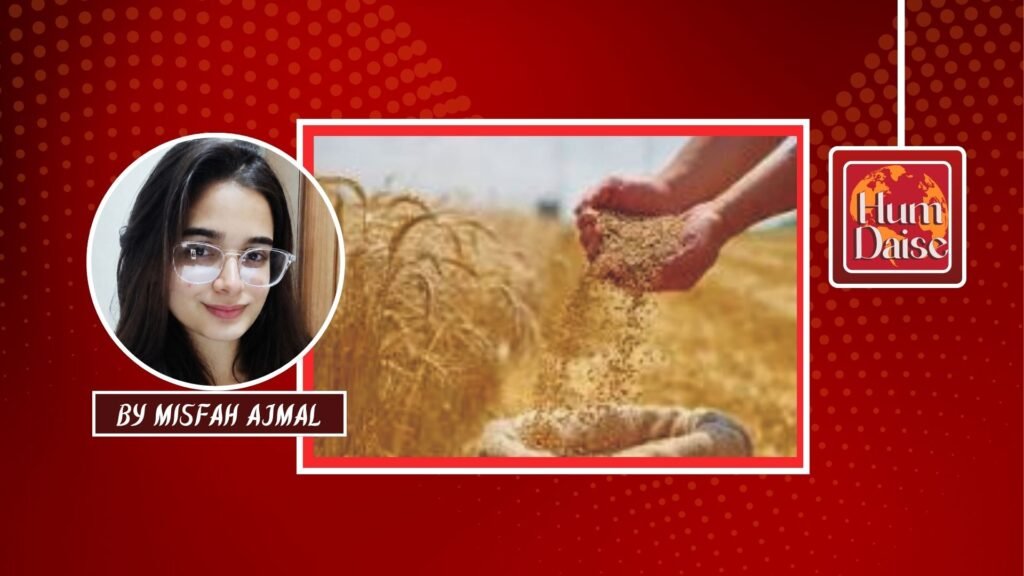
Misfah Ajmal
Wheat did not arrive in the Indus basin with the British. The Empire’s decisive intervention was to reorganize land, water and transport around commodity production—then route the harvest through Karachi to distant markets. Pakistan inherited that wheat-centered infrastructure and later deepened it in the name of food security. The result is not a nation “poisoned” by wheat, but one that too often mistakes an abundant staple for an adequate diet .In 1910, Karachi handled more wheat than any other port in the British Empire. Almost all of it had travelled from the canal-irrigated fields of Punjab, bound for Britain, Western Europe
and Japan. The transformation was so extensive that wheat helped turn Karachi from a regional harbour into a major node in an international commodity chain.That history matters because Pakistan still organizes much of its food system around the same
grain. Wheat occupies more land than any other crop, shapes price politics and remains the basis of the everyday roti. Yet the country continues to face severe malnutrition, poor dietary diversity and micronutrient deficiencies.This is the wheat trap: not the existence of wheat, and not gluten for the population as a whole, but a system that treats one crop as the foundation of agriculture, food security and nutrition all at once.
Wheat Was Here Before Empire
Any honest account must begin by rejecting a tempting but inaccurate claim: the British did not introduce wheat to the lands that became Pakistan. Archaeobotanical research at Harappa shows that wheat and barley were cultivated in the Indus region thousands of years before colonial rule. Other crops—including millets, pulses and oilseeds—also appeared across the wider Indus food world, in combinations that varied by place, season and access to water. There was no single precolonial diet waiting to be
destroyed, nor was wheat an alien food imposed on an entirely millet-eating population.What changed under British rule was wheat’s scale, geography and economic purpose. A familiar cereal became a strategic commodity. Canal water, land settlement, railways, market towns, grain depots and Karachi’s port were assembled into a system capable of producing and moving enormous surpluses.That distinction is essential. Colonialism did not create wheat consumption in Pakistan. It helped create a wheat frontier
How Colonial Rule Built a Wheat Frontier
After the British annexed Punjab in 1849, the colonial state gradually extended its control over the province’s land and water. From 1885, it established nine “canal colonies” across western Punjab—mostly in territory that later became part of Pakistan. New canals drew water from the rivers into semi-arid interfluves, while planned settlements brought cultivators into newly irrigated tracts.This was a remarkable feat of hydraulic engineering, but it was never a neutral development project. As historian Imran Ali documents in The Punjab Under Imperialism, 1885–1947, the state controlled canal water, decided how Crown land would be allotted and determined thetenurial rules under which it would be held. Land grants served fiscal, political and military objectives; large landholders and other influential groups were among the principal beneficiaries.Canal irrigation expanded cultivation and raised output. It also made agriculture more legible and extractable: officials could measure land, regulate water, collect revenue and encourage crops suited to distant markets. Wheat and cotton were especially important because they could be aggregated, transported and sold at scale.The colonial system did not eliminate subsistence farming or force every cultivator into a single crop. Farmers continued to grow and eat wheat, barley, gram, maize and millets. But official infrastructure and commercial opportunity increasingly rewarded particular. commodities. Even the 1908 Imperial Gazetteer of India described wheat in Punjab as both a
common food and a principal crop “grown for sale.”Colonial capitalism’s influence therefore lay less in dictating every meal than in determining which crops received water, transport, market access and state attention.
From Punjab’s Canals to Karachi’s Docks
The canal colonies would not have become a global wheat frontier without railways and a port.Rail lines connected Punjab’s new market towns and irrigated fields to Karachi. The port, in turn, was enlarged with wharves, warehouses, cranes, dredged channels and export yards.According to the Harvard Mellon Urban Initiative’s research on Karachi’s “commodity revolution”, wheat exports from Karachi exceeded one million tons in 1903–04. Growing grain traffic then drove further investment in port capacity.
This is the clearest Pakistan-specific image of the colonial wheat economy: water diverted into Punjab’s fields, grain loaded onto trains, and ships carrying it out through Karachi.The system certainly created production, trade and urban growth. But its priorities were those of an empire. Success was measured in irrigated acreage, marketable output, state revenue and export volume—not in the diversity or nutritional quality of local diets. The people who supplied the labour did not necessarily receive an equal share of the new wealth, while control over land and water reinforced existing hierarchies. Sindh entered this hydraulic order through its own history. The Sukkur Barrage, sanctioned in 1923 and opened in 1932, anchored a vast network of perennial canals. Wheat was one of several major crops supported by the system, alongside cotton, rice and sugarcane. Punjab and Sindh were not transformed in identical ways, but both were drawn more tightly into large-scale, state-managed irrigated agriculture.
Independence Deepened the Wheat Logic
Pakistan inherited the productive heart of the western Punjab canal colonies, Karachi’s port and a powerful administrative belief: national stability depended on controlling staple grain.That belief was understandable. A new country facing rapid population growth, poverty,volatile harvests and foreign-exchange constraints could not treat wheat casually.Governments invested in irrigation, agricultural research, procurement, storage, flour supply and price management. In the mid-1960s, the Green Revolution introduced high-yielding wheat and rice varieties alongside greater use of fertilizer, pesticides, tube wells and controlled irrigation. A World Bank study of the Pakistani and Indian Punjabs dates the arrival of this technology package to that period. The gains were real: wheat yields and production rose, and the risk of catastrophic grain shortage receded. It would be wrong to dismiss those achievements simply because thesystem had colonial roots.But the postcolonial state reinforced a hierarchy already embedded in fields and institutions.Wheat remained the crop most closely associated with food security and political legitimacy.Procurement targets, support prices, public storage and flour-market interventions concentrated official attention on keeping wheat available and roti affordable. Other foods essential to a balanced diet—pulses, vegetables, fruit, dairy, eggs and diverse grains—did not acquire the same symbolic or administrative status.Continuity does not mean that Pakistan merely copied a colonial policy. The aims changed from imperial commerce to national survival and price stability. The infrastructure, however,
made a wheat-first strategy easier to extend than a genuinely diverse food system.
The Health Blind Spot
Wheat is an efficient source of energy and supplies protein, fibre, B vitamins and minerals,especially when eaten as whole grain. It can be part of a healthy diet. The problem begins when its availability is used as a substitute for diet quality.Pakistan’s official Dietary Guidelines for Better Nutrition describe diets among both poor and non-poor households as energy-dense and insufficiently diverse. They estimate that wheat provides 52 percent of calories in poorer diets and 46 percent in better-off diets. The guidelines do not call for eliminating wheat. They recommend reducing refined cereals,making at least half of cereal intake whole grain and increasing foods such as pulses,vegetables, fruit, milk and animal-source foods according to need and affordability.The distinction between calories and nutrition is visible in the 2018 National Nutrition Survey. It found stunting in 40.2 percent of children under five, wasting in 17.7 percent and anaemia in 53.7 percent of children aged 6–59 months. Among children aged 6–23 months, only 14.2 percent received the minimum dietary diversity and just 3.6 percent received a
minimum acceptable diet. Those figures cannot be blamed on wheat alone. The survey identifies a web of causes poverty and food insecurity, poor infant and young-child feeding, disease, inadequate water and sanitation, limited health services, maternal nutrition and unequal access to varied foods.Wheat dependence belongs inside that larger system. A plate dominated by roti may prevent.immediate hunger while still leaving too little room—or too little household money—for protein-rich foods, vegetables, fruit and other sources of micro nutrients. This is why a full granary can coexist with widespread malnutrition. Staple security is
necessary, but it is not nutritional security.
Wheat, Gluten and Celiac Disease: What the Evidence
Says
The health blind spot also works in another direction. Because wheat is treated as universal,people with genuine wheat-related disorders can be overlooked. But concern about under diagnosis must not become the false claim that gluten is harmful to everyone. Celiac disease is a chronic immune disorder in which gluten—proteins found in wheat, barley and rye—damages the small intestine in genetically susceptible people. It is different from wheat allergy, which is an allergic reaction to wheat proteins, and from non-celiac gluten sensitivity, a diagnosis considered only after celiac disease and wheat allergy have been excluded. Irritable bowel syndrome can produce similar symptoms but is not the same condition.Pakistan does not yet have a reliable national prevalence estimate for celiac disease. A 2019 bibliographic review in the Journal of the Pakistan Medical Association found that the local evidence consisted mainly of small patient series and case reports concentrated in Sindh and Punjab. More recent hospital studies show that Pakistani patients can present with both intestinal and non-intestinal symptoms, but clinic samples cannot be used to calculate prevalence in the general population.Therefore, claims that a large share of Pakistanis have a “gluten allergy,” or that modern wheat has caused a national celiac epidemic, are not supported by current evidence. Celiac
disease is real and can be serious, but it is neither created by colonialism nor a diagnosis that should be assumed from bloating, fatigue or anaemia alone.For people with persistent symptoms, unexplained iron-deficiency anaemia, growth problems, a close relative with celiac disease or another recognized risk factor, appropriate medical evaluation matters. The US National Institute of Diabetes and Digestive and Kidney Diseases explains that diagnosis generally uses blood tests and, when indicated,small-intestinal biopsies. Patients should not begin a gluten-free diet before testing, because removing gluten can make the results inaccurate.For confirmed celiac disease, a strict lifelong gluten-free diet is essential. That creates a distinct access problem in Pakistan: reliable labelling, protection from cross-contact, affordable alternatives and trained dietetic support are limited. Addressing those needs is more useful than turning gluten-free eating into a universal wellness prescription
Whole Wheat Is Not Refined Flour
Another common error is to discuss every wheat product as though it were nutritionally identical.Whole-wheat atta retains more of the bran and germ than highly refined flour, and therefore generally contains more fibre and micronutrients. Refining grain changes its nutritional profile; turning refined flour into biscuits, pastries or fried foods adds further variables such as sugar, salt and fat. The health effects of a minimally processed whole-grain roti cannot be inferred from studies of ultra-processed wheat-based snacks.This does not make every atta automatically whole grain, nor every roti a complete meal.Milling practices vary, portion size matters and what accompanies the roti matters even more.But it does mean that “wheat” is too broad a category for serious nutritional analysis.Millets, sorghum, maize, barley and rice can widen cereal diversity. Pulses can add protein, fibre and minerals. Yet no single replacement grain is a cure-all, and plant foods such as millets and pulses do not naturally supply reliable vitamin B12. The goal is a more varied plate, not the substitution of one dietary monoculture for another.
The Trap Is Dependence, Not Wheat
The scale of Pakistan’s dependence is visible in its fields. The Ministry of National Food Security and Research reported that wheat covered 9.6 million hectares and produced 31.4 million tonnes in 2023–24. By comparison, the four major pulses—gram, mung, mash and masoor—occupied about 1.01 million hectares and produced 372,700 tonnes. The ministry acknowledges that domestic pulse production falls well below national requirements and that the gap is filled through imports. These figures do not prove that wheat acreage should simply be transferred to pulses; crops differ in season, water needs, yields, markets and agronomy. They do show which foods the system is best equipped to produce at scale. Pakistan cannot abandon wheat without harming the people who depend on affordable flour.Nor should it try. The more credible task is to make wheat one strong component of foodsecurity rather than its definition.That would require policy to measure success not only in tonnes of grain, but also in the affordability and consumption of diverse, nutrient-rich foods. Agricultural research, extension, credit, insurance, procurement and storage can support pulses and climate-suitable coarse grains where they are agronomically viable. Social protection can help low-income households purchase eggs, dairy, fruit, vegetables and pulses rather than merely enough flour
to survive. Milling standards, fortification and honest labelling can improve the quality of the wheat people already eat. Health systems can train clinicians to recognize celiac disease and other wheat-related disorders without encouraging unnecessary dietary restriction. None of these measures requires declaring war on roti. They require seeing it clearly
Beyond the Wheat Trap
Colonial rule did not invent wheat in the Indus basin, and modern Pakistan did not passively inherit an unchanged imperial food system. The historical connection is more precise: British power reorganized land and water in western Punjab, linked production to Karachi and elevated wheat as a strategic commodity. Pakistan then adapted and expanded that infrastructure to pursue national food security.The strategy delivered calories and helped protect the country from grain scarcity. Its limitation is that the institutions built to secure a staple were never designed to secure a balanced diet. Escaping the wheat trap therefore means holding two truths together. Wheat is a valuable food for most Pakistanis, and celiac disease requires serious diagnosis and lifelong treatment for those who have it. At the same time, no single grain—however productive, affordable or culturally beloved—can supply everything a population needs.A full granary can prevent hunger. It cannot, by itself, create a healthy nation.











Leave a Comment
Your email address will not be published. Required fields are marked with *