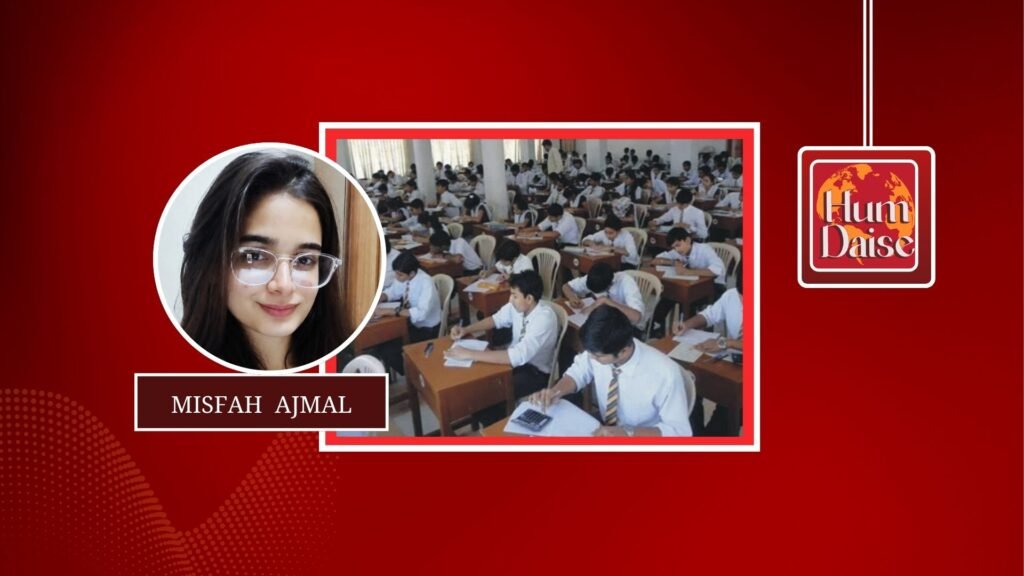
Misfah Ajmal
The Stakes of Standardized Assessment
In May 2026, the Board of Intermediate and Secondary Education (BISE) registered 99 unfair means cases during the recent SSC first annual examinations, following monitoring across 416 examination centers. While the detection of malpractice reflects vigilance, the figure also signals a deeper question: why, in an era of rapid global educational advancement, do systemic irregularities continue to surface within Pakistan’s most widely taken standardized examinations? For millions of students annually, the matriculation and intermediate board examinations represent the single most consequential gateway to higher education and professional opportunity. Yet mounting evidence—from official examination data to independent research—suggests that the system is producing outcomes that do not always reflect student capability, while inadvertently rewarding memorization over comprehension, and connections over competence. This article examines the structural gaps within the board examination framework and argues for evidence-based reform that restores public trust and educational equity.
The Board System in Context
Pakistan’s 28 Boards of Intermediate and Secondary Education (BISE) were established as statutory bodies to standardize secondary and higher secondary assessment across provinces. Collectively, they oversee examinations for millions of students transitioning from grades 9–10 (SSC) and 11–12 (HSSC). However, the institutions responsible for national assessment are operating within a broader environment of chronic under-investment. According to the Pakistan Economic Survey 2024–25, cumulative federal and provincial education expenditures during the first three quarters of FY2025 were estimated at merely 0.8 percent of GDP—a figure that has declined consistently from 2 percent in 2018. This places Pakistan well below the UN-backed Incheon Declaration recommendation of 4–6 percent, and behind regional peers such as India, which allocates 4.1 percent of GDP to education. Against this fiscal backdrop, the Annual Status of Education Report (ASER) 2025 notes that Pakistan has approximately 26.2 million out-of-school children, and only 12.4 percent of grade 3 students can read a grade 2–level story. When foundational learning outcomes remain this low, the integrity of terminal board examinations becomes not merely an administrative concern, but a national development imperative.
The Core Problem: Structural Gaps in Examination Integrity
1. Assessment Quality and Examiner Capacity:
A 2016 report by the Society for the Advancement of Education (SAHE) found that almost all BISEs lack technical and professional staff with the skills to effectively design, score, and analyze examinations. Paper development and scoring activities are largely outsourced, and research staff are “virtually nonexistent.” Paper setters and examiners are typically drawn from public school teachers, selected primarily on the basis of teaching experience rather than assessment literacy. While BISE Abbottabad requires a minimum of three years’ teaching experience for sub-examiners and seven years for head examiners, experience alone does not guarantee expertise in standardized scoring, rubric application, or bias mitigation. Independent research on Lahore BISE further indicates that examinations tend to assess memorization potential rather than creativity or critical thinking, producing negative washback effects on classroom instruction. The result is a system where students report that their written answers and awarded grades often feel disconnected, and where rechecking mechanisms—intended as safeguards—are perceived by candidates as procedural formalities rather than genuine academic review.
The Practical Examination Deficit
For science students, the practical component carries significant weight—25 marks are allocated for physics, chemistry, and biology practicals in class 10. Yet the infrastructure to support meaningful practical learning remains severely inadequate. According to records cited by The Express Tribune, Punjab has approximately 8,950 high and higher secondary schools, but only 5,000 laboratories, of which merely 300 are equipped with modern apparatus. Only an estimated 10 percent of government schools are able to facilitate students in preparing for practical examinations. A UNESCO-cited study further notes that over 90 percent of government schools in Pakistan lack adequate physical facilities and trained teachers for science instruction. Where laboratories exist, they are often non-functional, converted into classrooms or storerooms, and deprived of essential apparatus and technical staff. Consequently, students are compelled to rely on private coaching centers for practical preparation, paying fees that can reach Rs. 21,000 for three subjects—an impossible sum for many families. This creates a two-tier system where access to practical marks is determined not by school quality, but by household income.
Examination Integrity and Equity:
The recent registration of 99 unfair means cases, alongside recurring reports of paper leakage and seat manipulation, points to vulnerabilities in examination security. While the BISE control center’s monitoring of 416 centers is a step toward accountability, the persistence of these cases suggests that deterrence alone is insufficient without addressing the incentives and pressures that drive malpractice. Students and educators report that the “approach system”—wherein influence or connections determine outcomes—remains an informal but widely acknowledged reality. When examination outcomes are perceived as negotiable, the legitimacy of the entire credentialing system is eroded, and the psychological toll on students who rely solely on merit becomes profound.
Perspectives and Voices: The Human Cost:
The voices most affected by these gaps are often the least heard. Students from under-resourced government schools, female candidates in rural examination centers, and families without social or financial capital bear the disproportionate burden of systemic failure. Students consistently describe a climate of uncertainty: a full year of preparation undermined by opaque grading, inaccessible rechecking, and practical examinations that test rote memorization of procedures rather than genuine scientific understanding. For young women, safety concerns in under-staffed and poorly supervised practical centers add an additional, rarely documented layer of anxiety. The prevailing sentiment among affected students is not cynicism, but resignation—the belief that “this is the board system; nothing can be changed.” This learned helplessness is perhaps the most damaging outcome of all, teaching a generation that effort and integrity do not guarantee fair reward.
Steps Taken and Their Limits:
The government has demonstrated awareness of these challenges. Strictness in examination monitoring has increased, control centers have been activated, and unfair means committees have been constituted to adjudicate malpractice cases. The Prime Minister’s declaration of an “education emergency” in 2024 signaled high-level political recognition of the crisis. At the infrastructure level, provincial development programs include allocations for science laboratories, IT facilities, and school upgrading. The federal PSDP for FY2025 earmarked Rs. 92.1 billion for the education sector, including higher education. However, strictness without systemic reform addresses symptoms, not causes. Monitoring can detect cheating, but it cannot compensate for under-qualified examiners, inadequate laboratories, or assessment designs that privilege memorization over mastery. Increased funding, while welcome, has yet to reverse the decline in education’s share of GDP or close the gap between intended curriculum and classroom reality.
Gaps and Unanswered Questions:
Several critical questions remain unresolved: ● Examiner Accountability: What standardized training and calibration mechanisms exist for examiners? How is inter-rater reliability ensured across thousands of marked scripts? ● Rechecking Transparency: To what extent do rechecking processes involve substantive re-evaluation rather than administrative re-tallying? ● Practical Assessment Validity: Can practical examinations remain credible when the majority of government schools lack functional laboratories? ● Equity Monitoring: Is there disaggregated data on failure and supply rates by school type (public vs. private), gender, and district to identify patterns of inequity? Without answers to these questions, policy responses risk being reactive rather than restorative.
Conclusion and Call to Action: Toward a Just Examination Framework:
Education, at its core, is meant to expand horizons and cultivate coherent cognitive engagement—not to train students to mimic expected headings for examiner approval. When the board system becomes a source of mental pressure rather than a measure of learning, it forfeits its legitimacy as a credentialing authority. Reform is not only possible; it is imperative. The following evidence-based steps can guide the way forward: 1. Professionalize Assessment: Establish a centralized examiner training and certification program, with ongoing calibration sessions and blind double-marking for borderline cases. 2. Invest in Practical Infrastructure: Direct a measurable portion of education development funds specifically to functional science laboratories, equipment, and lab attendant staffing in government schools, with public audits of progress. 3. Transparent Rechecking: Institute a digital rechecking portal where students can access annotated feedback on their scripts, ensuring that review processes are substantive and documented. 4. Equity Audits: Mandate annual public reporting of examination outcomes disaggregated by school sector, gender, and region to identify and address disparities. 5. Curriculum-Assessment Alignment: Redesign examination papers to reduce rote memorization and elevate critical thinking, creativity, and problem-solving—skills that Pakistan’s youth urgently need. The board examination system is not beyond repair. Pakistan has previously demonstrated the capacity to prioritize education, as seen in 2006 when education’s share of government spending reached 15.3 percent. What is required now is the political will, administrative transparency, and public accountability to ensure that every student who sits for a board examination does so with confidence that their future will be determined by their knowledge, not their connections. The time for awareness has passed. The time for structural action is now.
Author


















Leave a Comment
Your email address will not be published. Required fields are marked with *