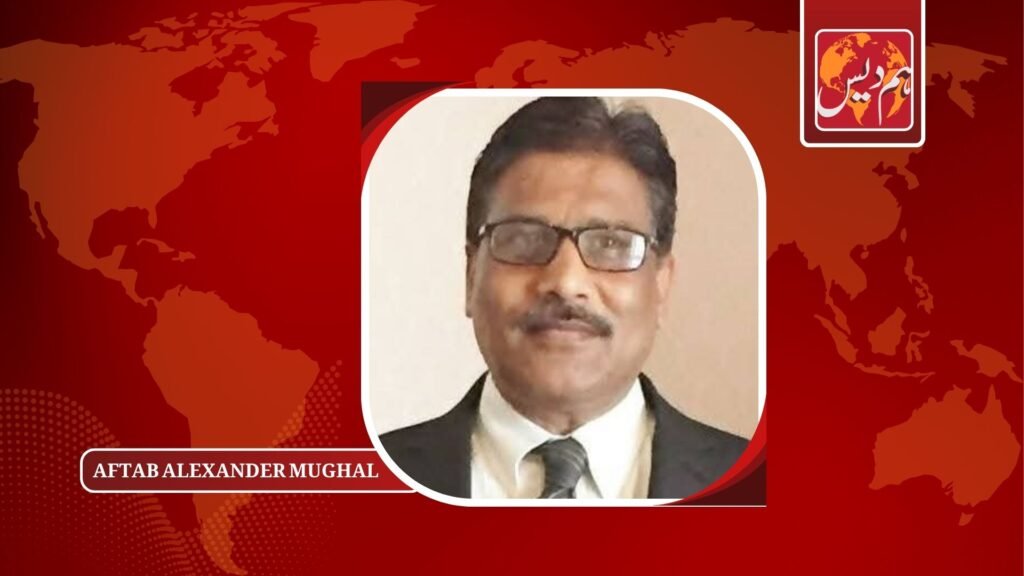
Aftab Alexander Mughal
Child marriage remains widespread in Pakistani society, particularly among poor and less-educated communities. This practice has grave consequences for the health and well-being of children, especially young girls. While some view it as rooted in social customs and religious beliefs, others consider it as inhumane and a violation of girls’ fundamental rights. International frameworks, including the Convention on the Rights of the Child (CRC) and the Convention on the Elimination of All Forms of Discrimination Against Women (CEDAW), define child marriage—any union involving a person under 18—as a human rights violation that undermines health, education, and autonomy. Consequently, many voices have long called for addressing this issue in line with human rights standardsA positive development emerged on 13 April, when the Punjab Assembly’s Standing Committee on Local Government and Community Development approved the Child Marriage Restraint Bill 2026. This came despite reservations from some conservative members, including the committee’s chairperson, PML-N MPA Pir Ashraf Rasool, who argued that the bill contradicts prevailing social and religious realities. The proposed legislation sets the minimum marriage age at 18 for both genders.Previously, under the Punjab Child Marriage Restraint Act of 1929, the legal age was 18 for men and 16 for women. Earlier, in February 2026, Punjab Governor Saleem Haider had promulgated an ordinance establishing 18 as the minimum age for both genders, though it is set to expire after three months. The current bill, therefore, represents a timely and necessary step. Following committee approval, it will now be presented to the Punjab Assembly for final passage.The legislation aims to curb underage marriages, eliminate gender-based discrimination, and strengthen child protection laws across Punjab, the country’s most populous province. Religious minority communities have cautiously welcomed the bill, expressing hope that it will help reduce incidents of forced conversion and forced marriage of Christian and Hindu girls.The abduction, forced conversion, and forced marriage of minority girls—many of them minors—remain serious concerns for non-Muslim citizens. Minority groups and human rights organisations have consistently raised alarm over these abuses, which disproportionately affect already marginalised communities.Minority Concern, a minority rights organisation, described the bill as a step in the right direction. However, it cautioned that even if enacted, effective implementation will take time, as the issue is deeply intertwined with religious, cultural, and social dynamics.According to human rights groups, hundreds of Christian and Hindu women and girls—many of them minors—fall victim each year to forced conversions and marriages.A recent judgment by the Federal Constitutional Court (FCC) has further intensified concerns, sparking nationwide protests among Christians. On 25 March, the court upheld the marriage of a 13-year-old Christian girl, Maria Shahbaz, to a 30-year-old man.This development underscores the urgency of legislative reform. Punjab’s proposed child marriage law could mark a turning point in Pakistan’s broader struggle to safeguard child rights.Christian leaders, including church authorities, strongly rejected the verdict, warning that it may set a dangerous precedent and leave Christian girls vulnerable to forced marriages with their abductors.In a pastoral letter dated 3 April, Archbishop Khalid Rehmat of Lahore expressed deep anguish over the decision, calling it “profoundly disturbing” and “unacceptable.” As head of the country’s largest Catholic diocese, he stated that the ruling “represents not only a grave failure of justice in Maria’s case but also sends a dangerous message that undermines the rule of law and weakens protections for vulnerable minority girls.”On the same day the Punjab bill was approved, members of the Christian community and civil society activists staged a protest at the grounds of St Patrick’s Cathedral in Karachi. Catholic Archbishop Benny Mario Travas of Karachi said the community was deeply disturbed by the ruling, adding that the large turnout reflected widespread concern and calling for an immediate review of the decision.Seeking to reassure the Christian community during an Easter gathering in Lahore, Federal Minister for Information and Broadcasting Attaullah Tarar promised that the government would address the issue.There are also reports that the federal government has formed a 37-member national committee—including church leaders, politicians, and human rights activists—to review the case and propose safeguards against forced conversions and marriages. However, the committee has yet to be formally notified.Similarly, the Punjab government constituted a 37-member committee on 6 April to address related concerns.In parallel, Christian parliamentarian Phalbous Christopher, a Member of the Punjab Assembly and Chairman of the Standing Committee on Minority Affairs and Human Rights, introduced a separate bill on 9 April. The bill aims to protect Christian women, particularly minor girls, by proposing amendments to the colonial-era Christian Marriage Act of 1872, which has remained in force for over 150 years.The issue holds particular significance in Punjab, which is home to approximately 80 percent of Pakistan’s Christian population. Catholic priest Fr. Khalid Rashid Asi from Faisalabad and senior lawyer Lazar Allah Rakha from Bahawalpur emphasised that any legislation on minimum marriage age and minority protection should not be rushed. They stressed the need for a thorough consultative process involving church leaders, theologians, and other stakeholders, especially on matters concerning the marriage of Christian girls.Currently, Sindh, Balochistan, and the Islamabad Capital Territory have set the minimum marriage age at 18 for girls, while in Khyber Pakhtunkhwa—governed by former Prime Minister Imran Khan’s party—the minimum age remains 16. Human rights organisations hope that all provinces will soon adopt a uniform minimum marriage age in line with international standards, which could help reduce cases of abduction, forced conversion and forced marriages across Pakistan.
Author
















Leave a Comment
Your email address will not be published. Required fields are marked with *