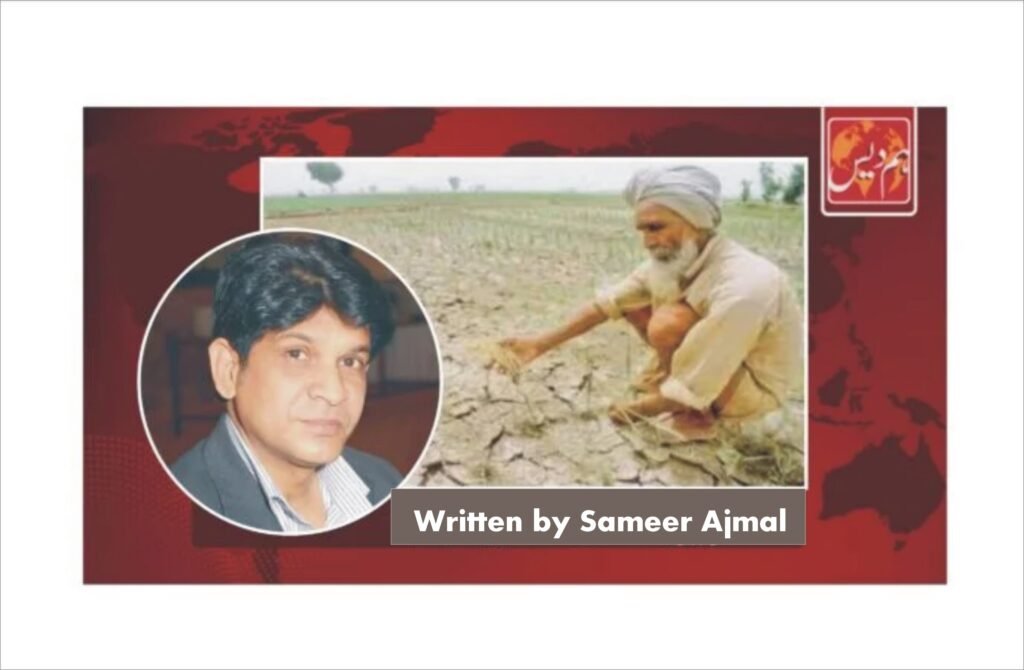
Sameer Ajmal
Before the creation of Pakistan, the British government, under a resettlement scheme, established separate villages for minority communities and allotted them agricultural land to help economically empower the marginalized. The idea was that these communities would grow their own food, earn their livelihood, and live self-sufficiently. Ideally, the land allotted by the British to minorities should have proven beneficial and increased over time. However, the situation has turned out quite the opposite—rather than gaining more land, minorities are gradually losing even the land that was originally allotted to them.Basharat Masih belongs to a village near Multan called Chak No. 13 MR, which was established in 1943, before the formation of Pakistan. The entire population of the village comprised Christians. Basharat Masih’s ancestors were allotted one “murabba” (25 acres) of land in this village, which they worked hard to cultivate and make fertile. But now, only two acres of that land remain. As a result, Basharat is deeply worried. He says that his family depended entirely on that agricultural land for their livelihood, enabling them to live with dignity. However, due to climate change, agricultural yield and income have significantly declined, forcing his family to sell off most of the land. Now, with growing household expenses and more family members to support, the two remaining acres are no longer sufficient to sustain them.This is not just Basharat Masih’s story—almost all villages in Punjab that were either established by or designated for minority communities are facing a similar situation. Agricultural lands have been sold off, making survival increasingly difficult for the residents.
Background of Minority Villages’ Settlement:
Chaudhry Nathaniel Masih, an elder resident of Chak No. 13 MR, says that before the creation of Pakistan, the British government, under a planned initiative, allotted separate lands for marginalized communities—including religious minorities—so they could live with dignity. These specific villages, where the minority population is high, were settled by minority communities themselves. In Punjab, there are about 200 such villages. At the time of allotment, both the size of agricultural land and the number of settlers varied, but under the standard procedure set by the British government, each settler was given one murabba (25 acres) of land.This land was highly fertile at the time of settlement, but over time, it began to suffer from the effects of climate change.difference Between the Situation at the Time of Settlement and the Present Day Master Jacob Aftab, a schoolteacher from Chak No. 13 MR, explains that at the time of settlement, the village comprised 52 murabbas (units of land), and all of this land was allotted to Christian families. There were 52 families, and each had one murabba (25 acres) of land. Now, however, around 200 families live in the village, and no one owns a full murabba anymore. Most of the land has been sold, mainly to non-Christians or Muslims.Since people from minority communities are generally economically weaker, they are unable to take measures to cope with climate and environmental changes. As a result, they are often forced to sell their land. On the other hand, people from majority communities are usually financially stronger and can afford alternative arrangements to deal with such challenges—like using tube wells during water shortages.At the time of settlement, the village had two Numberdars (village heads), both of whom belonged to the Christian community. Due to the sale of land, Christians have now lost even the Numberdari (village leadership).
Reasons for Land Sales and Migration in Villages
Chaudhry Gulzar Masih, an elder from Chak No. 13 MR, says that when he and his elders first settled in the village, canal water was abundant, and rainfall was regular. Now, however, canal water has decreased and rains have become infrequent, causing the land to turn barren. Due to the lack of productivity, people have been forced to sell their land. Kamran Masih, also from Chak No. 13 MR, has now migrated to the city of Multan. He says the village lacks both educational facilities and employment opportunities, which is why his parents left the village and moved to the city 30 years ago. Additionally, the underground water is saline, making it unsuitable for farming. These are the main reasons people are being compelled to migrate and sell their land.Chak No. 51 GB Khushpur, located in Faisalabad, is another village with a predominantly Christian population. It was established in 1898, and at the time of settlement, Christians were allotted 110 murabbas (units) of land. Gamiley L. Dogra, a resident of Khushpur and a social activist, says that 70% of the village’s land has already been sold. The major reasons include waterlogging and salinity, shortage of water, climate change, and other issues.
The Issue of Minority Vote Bank Fragmentation
Batemanabad, also known as Essa Nagri, is a village in Faisalabad. It was established in 1896 by a British missionary (pastor). At the time of settlement, the majority of the village population was Christian, and they collectively held 25 murabbas (units) of land. However, currently, Christians possess only 2 murabbas of land in the village.An elder of the village, Basheer Masih, states that due to waterlogging and salinity, water shortages, climate change, lack of employment, and generally unfavorable conditions, residents have been forced to sell their land and migrate elsewhere.Pastor James Masih says that the sale of land and migration due to such harsh circumstances has not only caused economic loss to the minorities but has also severely impacted their vote bank. As residents of a village move to other locations, their votes are either removed or transferred from the original area. This has led to the fragmentation of the minority vote bank in Punjab, resulting in a steady decrease in their collective electoral strength.
Essential Measures to Address the Challenges Faced by Minority Villages
Dr. Yousaf Riaz, a presidential award-winning agricultural scientist, has initiated a land restoration program in Chak No. 51 GB Khushpur with the support of the Bishop of Faisalabad and the Catholic Church. Dr. Yousaf states that most minority villages in Punjab are affected by waterlogging, salinity, and alkaline soils. To restore such lands, alternative crops that are resistant to these conditions can be cultivated. Additionally, the construction of drainage systems (sim nullahs) and the adoption of modern agricultural technologies are essential to preserve the land.He further explains that in Khushpur, a land restoration initiative has been started through self-help efforts. Although it’s an expensive project, it can serve as a model. If the government provides funding, similar projects can be launched in other minority villages as well, which could help prevent the sale of land and the migration of residents.
Author
















Leave a Comment
Your email address will not be published. Required fields are marked with *