
By: Bishop Dr. Ijaz Inayat Masih.(Late)
Lust, hatred, fear, rejection, competition and likewise could be the main reasons for the growing anti-peace activities all over the world in which individuals, groups and even Geo-political factors play a great part.
Over the period history is full of such incidents which civilized societies describes as anti-human, yet the world leadership has miserably failed to halt infliction to the human race.
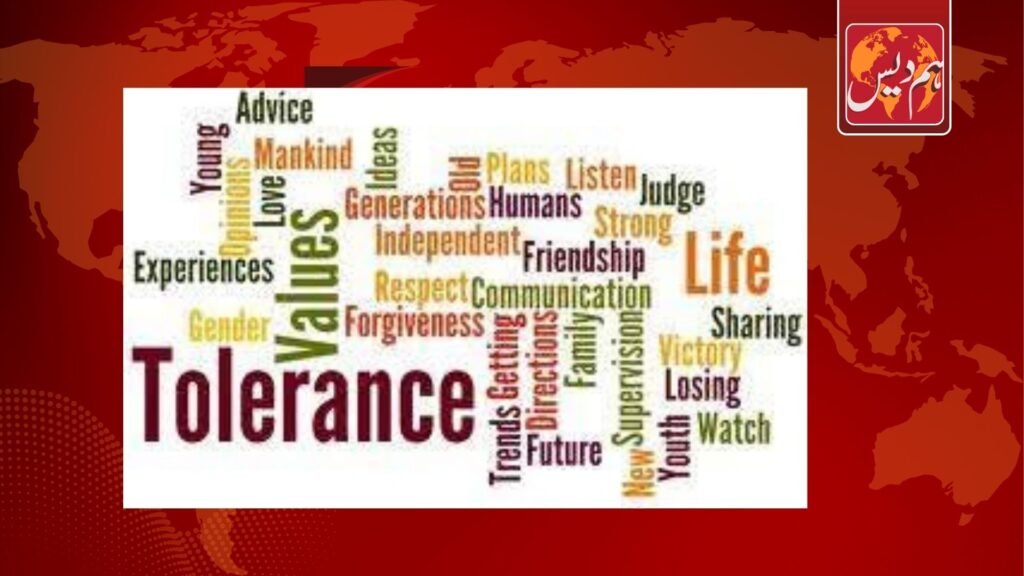
In 1905, UN, once again pledged and wrote down its commitment to enhance peace in the world. 16th November was written as the “INTERNATIONAL DAY FOR TOLERANCE”-highlighting the need to work hard as a global community for peace and emphasizing on “TOLERANCE in all walks of life. I personally feel every individual on the planet is in debt to this subject.
If understood, all mankind is bound to be a partner in the enhancement of TOLERANCE to enable peace in the world.
The Secretary-General of UN, Mr. Ban Ki-moon says this,
“On this International Day of Tolerance, I call on all people and governments to actively combat fear, hatred and extremism with dialogue, understanding and mutual respect. Let us advance against the forces of division and unite for our shared future.”
To achieve this and in order to be a proactive participant in this drive we need to study the following for our own learning and onward transfer to the coming generations.
Fighting intolerance we need to have a closer look on (1) Laws and their honest enforcement. (2) Education, right from the early age of every child. (3) Access to information, enabling every individual to know what the Governments and cartels are doing? (4) Awareness on the individual level along with a commitment to say no to each and every action of intolerance. (5) Local solutions, involving society to be responsible to keep an eye on members to enhance their living conditions, way of thinking and acting.
*Hereunder is the resolution adopted by the UN.
Adopt and solemnly proclaim this Declaration of Principles on Tolerance
Resolving to take all positive measures necessary to promote tolerance in our societies, because
tolerance is not only a cherished principle, but also a necessity for peace and for the economic and
social advancement of all peoples,
We declare the following:
Article 1 – Meaning of tolerance
1.1 Tolerance is respect, acceptance and appreciation of the rich diversity of our world’s
cultures, our forms of expression and ways of being human. It is fostered by knowledge, openness,
communication, and freedom of thought, conscience and belief. Tolerance is harmony in difference.
It is not only a moral duty, it is also a political and legal requirement. Tolerance, the virtue that
makes peace possible, contributes to the replacement of the culture of war by a culture of peace.
1.2 Tolerance is not concession, condescension or indulgence. Tolerance is, above all, an active
attitude prompted by recognition of the universal human rights and fundamental freedoms of others.
In no circumstance can it be used to justify infringements of these fundamental values. Tolerance is
to be exercised by individuals, groups and States.
1.3 Tolerance is the responsibility that upholds human rights, pluralism (including cultural
pluralism), democracy and the rule of law. It involves the rejection of dogmatism and absolutism
and affirms the standards set out in international human rights instruments.3
1.4 Consistent with respect for human rights, the practice of tolerance does not mean toleration
of social injustice or the abandonment or weakening of one’s convictions. It means that one is free
to adhere to one’s own convictions and accepts that others adhere to theirs. It means accepting the
fact that human beings, naturally diverse in their appearance, situation, speech, behaviour and
values, have the right to live in peace and to be as they are. It also means that one’s views are not to
be imposed on others.
Article 2 – State level
2.1 Tolerance at the State level requires just and impartial legislation, law enforcement and
judicial and administrative process. It also requires that economic and social opportunities be made
available to each person without any discrimination. Exclusion and marginalization can lead to
frustration, hostility and fanaticism.
2.2 In order to achieve a more tolerant society, States should ratify existing international human
rights conventions, and draft new legislation where necessary to ensure equality of treatment and of
opportunity for all groups and individuals in society.
2.3 It is essential for international harmony that individuals, communities and nations accept
and respect the multicultural character of the human family. Without tolerance there can be no
peace, and without peace there can be no development or democracy.
2.4 Intolerance may take the form of marginalization of vulnerable groups and their exclusion
from social and political participation, as well as violence and discrimination against them. As
confirmed in the Declaration on Race and Racial Prejudice, ‘All individuals and groups have the
right to be different’ (Article 1.2).
Article 3 – Social dimensions
3.1 In the modern world, tolerance is more essential than ever before. It is an age marked by the
globalization of the economy and by rapidly increasing mobility, communication, integration and
interdependence, large-scale migrations and displacement of populations, urbanization and
changing social patterns. Since every part of the world is characterized by diversity, escalating
intolerance and strife potentially menaces every region. It is not confined to any country, but is a
global threat.
3.2 Tolerance is necessary between individuals and at the family and community levels.
Tolerance promotion and the shaping of attitudes of openness, mutual listening and solidarity
should take place in schools and universities and through non-formal education, at home and in the
workplace. The communication media are in a position to play a constructive role in facilitating free
and open dialogue and discussion, disseminating the values of tolerance, and highlighting the
dangers of indifference towards the rise in intolerant groups and ideologies.
3.3 As affirmed by the UNESCO Declaration on Race and Racial Prejudice, measures must be
taken to ensure equality in dignity and rights for individuals and groups wherever necessary. In this
respect, particular attention should be paid to vulnerable groups which are socially or economically
disadvantaged so as to afford them the protection of the laws and social measures in force, in
particular with regard to housing, employment and health, to respect the authenticity of their culture
and values, and to facilitate their social and occupational advancement and integration, especially
through education.
3.4 Appropriate scientific studies and networking should be undertaken to co-ordinate the
international community’s response to this global challenge, including analysis by the social
sciences of root causes and effective countermeasures, as well as research and monitoring in
support of policy-making and standard-setting action by Member States.
Article 4 – Education
4.1 Education is the most effective means of preventing intolerance. The first step in tolerance
education is to teach people what their shared rights and freedoms are, so that they may be
respected, and to promote the will to protect those of others.
4.2 Education for tolerance should be considered an urgent imperative; that is why it is
necessary to promote systematic and rational tolerance teaching methods that will address the
cultural, social, economic, political and religious sources of intolerance – major roots of violence
and exclusion. Education policies and programmes should contribute to development of
understanding, solidarity and tolerance among individuals as well as among ethnic, social, cultural,
religious and linguistic groups and nations.
4.3 Education for tolerance should aim at countering influences that lead to fear and exclusion
of others, and should help young people to develop capacities for independent judgement, critical
thinking and ethical reasoning.
4.4 We pledge to support and implement programmes of social science research and education
for tolerance, human rights and non-violence. This means devoting special attention to improving
teacher training, curricula, the content of textbooks and lessons, and other educational materials
including new educational technologies, with a view to educating caring and responsible citizens
open to other cultures, able to appreciate the value of freedom, respectful of human dignity and
differences, and able to prevent conflicts or resolve them by non-violent means.
Article 5 – Commitment to action
We commit ourselves to promoting tolerance and non-violence through programmes and
institutions in the fields of education, science, culture and communication.
Article 6 – International Day for Tolerance
In order to generate public awareness, emphasize the dangers of intolerance and react with renewed
commitment and action in support of tolerance promotion and education, we solemnly proclaim

















Leave a Comment
Your email address will not be published. Required fields are marked with *