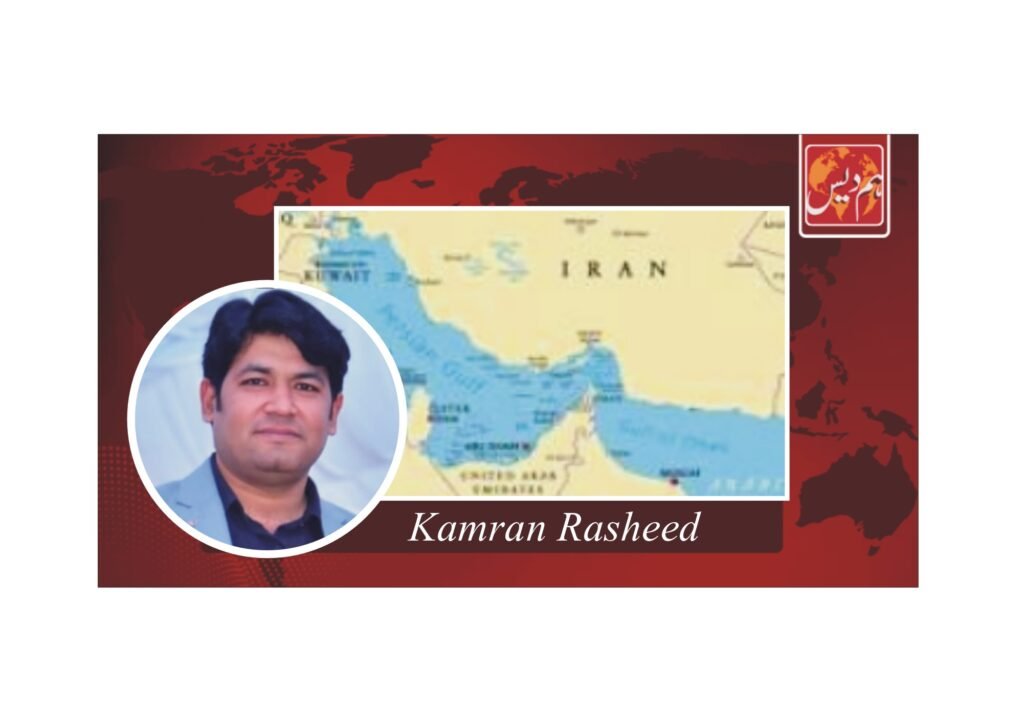
Kamran Rasheed
War involving Iran has intensified tensions in the Middle East, raising serious concerns about the security of one of the world’s most critical maritime chokepoints—the Strait of Hormuz. As conflict continues and regional instability grows, the risk of disruption in this vital waterway has become a central issue for global energy markets and international security.
The Strait of Hormuz lies between Iran and Oman, connecting the Persian Gulf with the Gulf of Oman and the wider Arabian Sea. Despite its narrow width, it carries nearly one-fifth of the world’s daily oil supply. Major oil-exporting countries such as Saudi Arabia, Iraq, Kuwait, and the United Arab Emirates depend heavily on this route to transport crude oil to international markets.
As war continues in the region, fears have increased that the Strait could face partial closure, military confrontation, or shipping disruptions. Any obstruction in this strategic route would immediately affect global oil markets. Oil prices would likely rise sharply, increasing the cost of fuel, transportation, and industrial production around the world. For many developing countries, this surge could lead to severe economic pressure and rising inflation.The geopolitical implications are equally significant. Global powers including the United States, China, and the European Union have strong strategic interests in keeping the Strait open. If the waterway becomes a battlefield or is blocked, international naval forces could intervene to secure maritime trade routes, increasing the risk of a wider regional confrontation.The instability could further weaken the already fragile security environment of the Middle East. Disruptions in shipping would not only affect oil but also global trade, as many commercial vessels pass through the region daily. Rising insurance costs and logistical delays could affect supply chains worldwide.For countries like Pakistan, the consequences could be particularly serious. Pakistan relies heavily on imported oil, and any sharp increase in global energy prices would directly raise fuel costs, electricity tariffs, and the prices of basic commodities. This could place additional pressure on the country’s already sensitive economic structure.
However, prolonged closure of the Strait would also have consequences for Iran itself, as much of its own oil exports pass through the same route. This reality highlights how interconnected global energy systems have become.
In conclusion, the ongoing war involving Iran has created a dangerous situation around the Strait of Hormuz, a waterway essential to global energy supply. Any disruption there would have far-reaching consequences for international trade, economic stability, and geopolitical security. In today’s interconnected world, the stability of this narrow maritime corridor remains vital not only for the Middle East but for the entire global economy.
Author


















Leave a Comment
Your email address will not be published. Required fields are marked with *